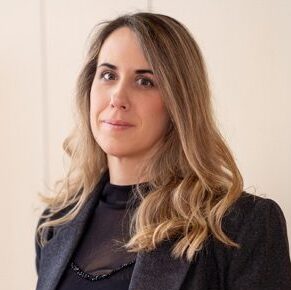
Lidija Bogović holds a PhD and is a senior research and teaching assistant in the Department of Croatology at the Faculty of Croatian Studies, University of Zagreb, as well as a research associate at the Institute for Migration Research. Her research and teaching interests include lexicology, word formation, dialectology and other areas of the Croatian language.
In the project, she monitors students’ language production, analyses how they express emotional states and contributes to the linguistic adaptation of teaching and research materials. Her expertise in lexicology, word formation, dialectology and linguistic stylistics enables precise analysis of students’ written reflections and creative texts.
Teaching and professional activities
At the Faculty of Croatian Studies, she assists in teaching the undergraduate courses Phonology of the Croatian Language, Croatian Dialectology and Croatian Orthography, as well as the courses Literature and Culture of Croats in the Diaspora, Lexicology and Lexicography of the Croatian Language, and Word Formation in the Croatian Language.
Since 2018, she has been an associate on the project Cooperation with Croatian Autochthonous Communities in the Diaspora, through which she has delivered several lectures for Croatian-language teachers in autochthonous Croatian minority communities in Hungary.
She has participated in a number of research projects devoted to the Croatian language, dialectology, migration, Croatian emigrant communities and Croatian-language teaching abroad.
Read more
Lidija Bogović, PhD, is a senior research and teaching assistant in the Department of Croatology at the Faculty of Croatian Studies, University of Zagreb, and a research associate at the Institute for Migration Research. She graduated in Croatology from the Centre for Croatian Studies, completing the research and teacher-education track with a thesis entitled Near-Synonymy in the Croatian Language.
She continued her education at the same institution in the postgraduate doctoral programme in Croatology. In 2024, she defended her doctoral dissertation The Role of Word Formation in the Croatian Language in the Second Half of the Nineteenth Century.
She has worked at the Faculty of Croatian Studies since 2019, initially as a research and teaching assistant and, since 2025, as a senior research and teaching assistant in the Department of Croatology. She assists in teaching the undergraduate courses Phonology of the Croatian Language, Croatian Dialectology and Croatian Orthography, as well as the graduate courses Literature and Culture of Croats in the Diaspora, Lexicology and Lexicography of the Croatian Language, and Word Formation in the Croatian Language.
Since 2025, she has also been employed as a research associate at the Institute for Migration Research.
An important area of her work concerns the Croatian language and Croatian communities outside Croatia. Since 2018, she has been an associate on the project Cooperation with Croatian Autochthonous Communities in the Diaspora, through which she has delivered several lectures for Croatian-language teachers in autochthonous Croatian minority communities in Hungary.
She is also secretary of the Summer School of Croatian Language and Culture for Croatian-language teachers from the diaspora, where she has delivered language exercises adapted to participants’ levels since the programme began.
She has also participated in research on the Croatian language in different communities. She was an associate on a dialectological study of speech on the inhabited islets of the Lošinj archipelago, a sociolinguistic study of the speech of different generations of Croats in Milan, and studies of Croatian-language proficiency among children attending Croatian classes in Ludwigsburg, Munich and Baden-Württemberg.
Her research also covers migration, identity and Croatian communities abroad.
In 2025, she was a member of the organising committee of the international scholarly and professional conference Croatian Language and Culture Abroad: Looking to the Past, Present and Future.
Within IUČIP, Bogović monitors students’ language production and analyses how they express emotional states in their writing. She also contributes to the linguistic adaptation of teaching and research materials. Her expertise in lexicology, word formation, dialectology and linguistic stylistics is applied to the analysis of students’ written reflections and creative texts.